"The modern human is literally eating themselves to death, not just through the toxicity of the food, but through the brutal, nonstop frequency of the feeding. Your cells have miraculous self-healing and fat-burning mechanisms, but those genetic pathways are hardwired to stay completely shut down as long as your digestive system is turned on. Fasting isn't starvation. It's the profound biological act of cleaning house."
Key Fasting Takeaways
-
1.
The 16:8 Framework: This is the most researched protocol in clinical endocrinology. You restrict all calories to an 8-hour daily window (for example, from 12:00 PM to 8:00 PM), letting your nervous system and digestive tract rest and heal for the remaining 16 hours.
-
2.
The Insulin Baseline: The main goal of the 16-hour fast isn't just cutting calories. The real aim is to push your circulating insulin down to its absolute baseline (below 3.0 µIU/mL), which physically unlocks the cellular vaults that trap belly fat.
-
3.
The "Fasting Flu" Myth: Headaches and severe fatigue during a fast aren't caused by low blood sugar. They come from a rapid flush of sodium and potassium from your kidneys. You can fix this instantly with clean electrolyte supplementation.
-
4.
Breaking the Fast: Ending your 16-hour fast with a huge plate of refined carbs (pancakes or pasta) is a metabolic disaster. You need to break the fast with quality fats and dense protein to avoid a catastrophic blood sugar spike.
If you watch any wild animal thriving in its natural habitat, you'll quickly realize that eating three square meals a day, plus two or three high-carb snacks, is a completely artificial, modern human invention. No other predator eats from the moment it wakes up until the second it falls asleep. Our ancestors routinely went through long periods of scarcity, punctuated by sudden feasts after a successful hunt.
That cycle of scarcity and abundance is the very rhythm that made humans exceptional. When your body goes without incoming calories for a while, it doesn't just sit around waiting to die. It actively optimises itself. It sharpens your focus to help you find food, spikes growth hormone (HGH) to protect your muscles, and smoothly switches from burning glucose to burning your deep, stubborn fat stores.
By 2026, the 16:8 Intermittent Fasting Protocol has moved way beyond simple dieting. It's now the gold standard, non-negotiable chronobiological tool used by elite biohackers, longevity doctors, and top neuroscientists.
The Hidden Biochemistry of Hour 14
Most people have never truly experienced a biochemically fasted state. Because the standard modern diet involves grazing for 15 to 16 hours a day (from the 7:00 AM sugary latte to the 11:00 PM late snack), your liver is stuck in a permanent, exhausting cycle of bile production and glucose processing.
When you cut your eating window down to just 8 hours, your body goes through a predictable, measurable transformation. For the first 10 hours of a fast, you're just digesting your last meal and burning through the stored glycogen in your liver. Nothing dramatic happens yet.
But right around the 14-hour mark, the real magic kicks in. Your liver realises it has run out of easily available glucose, so your pancreas lowers insulin and releases a hormone called Glucagon. Glucagon travels to your fat cells (especially belly fat) and tells them to open up, flooding your bloodstream with fatty acids. Your liver then turns those fats into ketone bodies, giving your brain a clean, steady surge of mental clarity exactly as you reach hour 16.
Biohacker Pro-Tip: The Autophagy Threshold
The 16:8 protocol is fantastic for fat loss and insulin reduction. But if your main goal is maximizing Autophagy (the cellular recycling process that clears out senescent "zombie" cells), 16 hours often isn't long enough. Autophagy really peaks between 24 and 48 hours. So the elite approach is to do 16:8 on weekdays and add a 24-hour water fast once a week for a deeper cellular clean.
Autophagy & Mitophagy: The Cellular Housekeeping
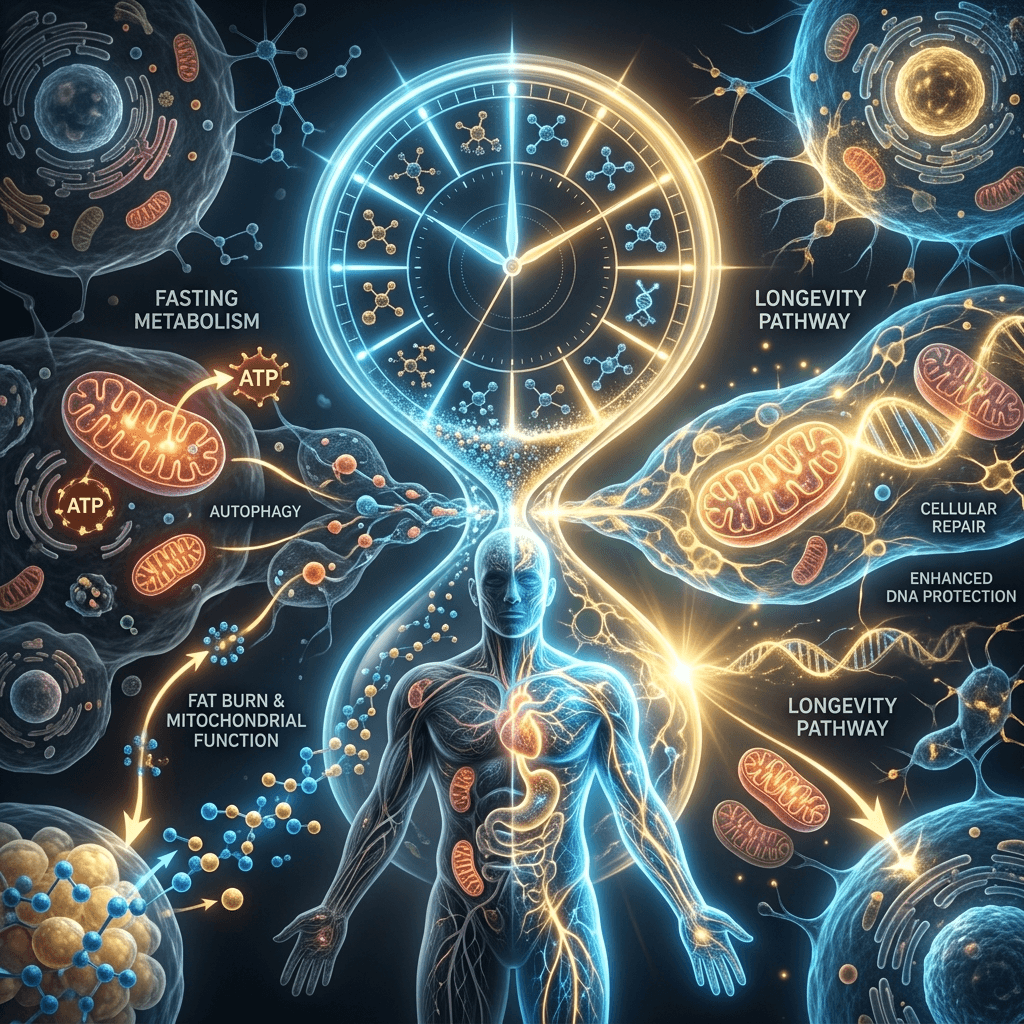
Autophagy (Greek for "self-eating") is the process by which your cells degrade and recycle damaged parts, misfolded proteins, and even pathogens. It runs at a low level all the time, but fasting massively ramps it up. The key controller is the mTOR pathway. When you have plenty of amino acids and growth factors, mTOR stays active and blocks autophagy. When you fast for 16+ hours, mTOR drops, and autophagy runs free.
Mitophagy is a specialised form of autophagy that targets broken mitochondria. Damaged mitochondria leak reactive oxygen species and inflammatory mitochondrial DNA into your cells, which triggers the NLRP3 inflammasome. By clearing out those defective mitochondria, mitophagy lowers systemic inflammation and stops the buildup of senescent cells. The 2026 consensus: 16:8 gives you mild mitophagy; 24-hour fasts give you robust mitophagy; and 48 to 72-hour fasts give you the deepest clean, but they need careful electrolyte management and medical oversight if you have metabolic issues.
| Fasting Duration | Key Metabolic State | Autophagy Level | Best For |
|---|---|---|---|
| 12-14 hours | Glycogen depletion, insulin dropping | Minimal | Getting started with fasting |
| 16-18 hours | Ketosis begins, glucagon elevated | Moderate (basal clearance) | Fat loss, insulin sensitivity |
| 24 hours | Deep ketosis, elevated HGH | Significant | Mitophagy, immune regeneration |
| 48-72 hours | Maximal ketosis, stem cell activation | Peak (zombie cell clearance) | Senolytic effect, deep metabolic reset |
16:8 Execution Guidelines & The Biohacker Toolkit
Intermittent fasting is biologically simple, but it's also easy to mess up if you don't understand the underlying physiology. To do 16:8 correctly without losing muscle or feeling terrible, follow these three absolute rules:
The Immaculate Fasting Window
The most common question in the fasting world is, "Does X break my fast?" The strict 2026 answer is that your fasting window needs to be chemically clean. If you consume cream, artificial sweeteners (like sucralose or aspartame), or bone broth during those 16 hours, you trigger a cephalic insulin response, which slams the door on deep fat burning.
The only liquids allowed during the fast are filtered water, black espresso, and unflavored green or black tea. Black coffee actually helps because it stimulates your nervous system and upregulates AMPK, pushing you into fat oxidation faster than fasting on water alone.
The Art of Breaking the Fast
After 16 hours of rest, your digestive enzymes and gut lining are basically in a deep sleep. Your cells are also super sensitive to insulin. If you smash a big bowl of cereal or bread into that environment, your insulin rockets up, causing a huge energy crash later.
The rule is simple: your first meal of the day must be protein and fat. A three-egg omelet cooked in ghee, half an avocado, and some wild salmon is perfect. It wakes up your digestion with almost no blood sugar spike, keeping your brain focused all afternoon.
The Missing Link: Fasting Electrolytes
About 95% of people who try 16:8 fail in the first week. They complain of migraines, brain fog, and muscle fatigue, insisting that their body "needs sugar." But the real problem is hyponatremia (salt depletion).
When insulin drops during hour 12 of a fast, your kidneys get a signal to dump retained water. As that water leaves, it takes hundreds of milligrams of sodium, magnesium, and potassium with it. If you don't replace those minerals during the fast, your nervous system starts to fail, causing a brutal headache. Smart biohackers don't suffer; they supplement with pure, zero-sugar fasting electrolytes.
Circadian Rhythms: Does the Fasting Window Matter?
A big debate in the biohacking community is exactly when your 8-hour eating window should be. While most advice says to skip breakfast and eat from 12:00 PM to 8:00 PM (for social convenience), modern chronobiology suggests a better way.
Studies show that your pancreas is much more sensitive to insulin in the early morning than late at night. So an elite biohacker who cares about blood sugar control will shift their eating window earlier. For example, eat a big breakfast at 9:00 AM, finish dinner by 5:00 PM, and then have zero evening calories. This approach (called Early Time-Restricted Feeding or eTRF) flattens your glucose curve, lets your stomach empty before bed, and gives you deeper, more restorative sleep with a bigger growth hormone pulse.
📊 eTRF vs. Late Feeding Window: 2026 Comparison
- eTRF (9 AM - 5 PM): Better insulin sensitivity, lower evening cortisol, deeper sleep, higher overnight ketones, improved morning alertness.
- Late Window (12 PM - 8 PM): Socially convenient, but linked to higher fasting glucose, delayed melatonin, and a smaller nighttime growth hormone pulse.
- Verdict: If your schedule allows, shift your window as early as possible. If not, 12-8 PM is still way better than constant grazing.
Advanced Fasting Protocols: The 36 Hour Fast and Beyond
While 16:8 is the most accessible and well-studied, advanced biohackers often use longer fasts for specific goals. Here's the 2026 hierarchy:
| Protocol | Feeding Window | Difficulty | Primary Benefit |
|---|---|---|---|
| 16:8 | 8 hours | Low | Insulin sensitivity, fat loss, sustainability |
| 18:6 | 6 hours | Low-Medium | Deeper ketosis, more autophagy |
| 20:4 (Warrior Diet) | 4 hours | Medium | Rapid fat loss, mental clarity, HGH spike |
| OMAD (23:1) | 1 hour | High | Extreme insulin reduction, autophagy, convenience |
| 5:2 (Modified) | 2 non-consecutive days at 500-600 kcal | Medium | Weight loss with less hunger, metabolic flexibility |
| 24-72h water fast | No food for 1-3 days | High | Peak autophagy, senolytic effect, immune regeneration |
Important note: Longer fasts (over 24 hours) need preparation with electrolytes. Don't attempt them if you have a history of eating disorders, type 1 diabetes, or are underweight. Always talk to a doctor before going beyond 24 hours.
Synergy: Fasting and Exercise
A common worry is whether to train while fasted. The 2026 evidence is clear: fasted Zone 2 cardio is incredibly beneficial, but fasted high-intensity intervals or heavy lifting might hurt performance for some people.
- Fasted Zone 2 (60-70% of max heart rate, 30-60 min): This speeds up fat burning, increases mitochondrial growth, and doesn't spike cortisol. Ideal for morning fasted sessions.
- Fasted HIIT or heavy lifting: May lower your power output and make the workout feel harder. If you choose to train fasted, keep it under 30 minutes and use electrolytes. Some people thrive; others crash. Experiment and see how you recover.
- Post-workout refeed: After a fasted workout, your muscle cells are super sensitive to insulin. Breaking your fast with protein and a small amount of carbs (like whey protein and a sweet potato) maximises glycogen storage and muscle repair.
Biohacker Pro-Tip: The "Train Low, Refuel High" Strategy
Periodise your training: do 2-3 fasted Zone 2 sessions per week to build metabolic flexibility. On days when you do HIIT or heavy leg work, break your fast with a small protein meal 2 hours before training. That gives you the best of both worlds: mitochondrial gains from fasting without losing performance.
Fasting for Women: Hormonal Considerations
Most fasting research has been done on men. New evidence suggests that premenopausal women may respond differently to long fasts because of the sensitivity of their hormonal axis. Chronic calorie restriction or very long fasts can disrupt menstrual cycles and lower thyroid output.
The 2026 female biohacker protocol:
- Premenopausal women: 14:10 or 16:8 is generally safe and effective. Avoid going over 18 hours daily. Add one 24-hour fast per month, ideally during the early follicular phase (days 1-7 of your cycle), when estrogen is lowest.
- Perimenopausal and postmenopausal women: Can handle longer fasts (up to 20:4 or 24 hours) because the hormonal axis is less sensitive. Many report fewer hot flashes and better metabolic health with eTRF.
- Warning signs: If fasting causes you to lose your period, shed a lot of hair, feel cold all the time, or have insomnia, eat more, shorten your fasting window, or increase carbs (especially after workouts).
Measuring Success: Ketones, Glucose, and HRV
To truly optimise your fasting, you need objective data. The 2026 biohacker uses:
- Blood ketone meter: Measures beta-hydroxybutyrate (BHB). The optimal range for metabolic health is 0.5-2.0 mmol/L. Levels over 3.0 mmol/L might mean you're eating too little (unless you're on a therapeutic keto diet for epilepsy).
- Continuous glucose monitor (CGM): Tracks your blood sugar swings. During a fast, glucose should sit between 70-90 mg/dL. If it keeps dropping below 55 mg/dL, break the fast.
- Heart rate variability (HRV): A sudden drop in HRV (for example, from 60 ms to 30 ms) means you're under too much stress. Shorten your fast or increase electrolytes.
The Refeeding Syndrome: Breaking a Long Fast Safely
After a fast of 48 hours or more, your body becomes depleted of phosphate. If you break the fast with a huge carb load, insulin surges and drives phosphate, potassium, and magnesium into your cells, causing a dangerous drop in blood levels. That's refeeding syndrome, and it can cause heart arrhythmias or even death in extreme cases.
The 2026 refeeding protocol for fasts over 48 hours:
- Break the fast with a small meal (200-300 calories) of easy-to-digest protein and fat, like bone broth with collagen or a few ounces of salmon.
- Wait 1-2 hours. See if you feel bloated, nauseous, or have diarrhoea.
- If you're fine, eat a full meal (30-40g protein, healthy fats, non-starchy vegetables).
- Avoid high-carb foods (bread, pasta, rice, fruit) for the first 24 hours after a long fast. Add them back slowly on day two.
- Supplement with electrolytes (sodium, potassium, magnesium, phosphate) before and after breaking the fast.
Weekly Fasting Protocol for Longevity (2026)
📅 Sample Weekly Schedule
- Monday - Friday: 16:8 fasting (feeding window 12 PM - 8 PM, or earlier if you do eTRF). Only black coffee and water outside the window.
- Monday - Friday morning: Fasted Zone 2 cardio (30-45 min) on at least three days.
- Saturday (every week or every other week): 24-hour fast (dinner Friday to dinner Saturday). Use electrolytes. Break with a protein and fat meal.
- Sunday: Normal eating day with no time restriction (but keep eating whole, nutrient-dense foods).
- Monthly: One 48-hour fast (for example, from Thursday dinner to Saturday dinner) to maximise autophagy and senolytic clearance. Use electrolytes and watch your HRV.
- Quarterly: Consider a 72-hour fast under medical supervision if you have severe metabolic disease or as part of a therapeutic protocol.
Adjust this based on your goals, sex, and recovery. Women may need to reduce how often they do 24+ hour fasts.
While a daily restricted feeding window is highly effective, transitioning to a periodic 36 hour fast triggers profound physiological shifts. By extending the fast past the 24-hour mark, liver glycogen stores are completely depleted, causing a complete metabolic switch to ketone production. This sustained state of ketosis amplifies systemic inflammation reduction, accelerates deep visceral fat burning, and stimulates deep macro-autophagy in tissues that are untouched during shorter fasting durations.
Conclusion: Incorporating a 36 Hour Fast Safely
Intermittent fasting isn't a diet. It's a return to the biological rhythm that shaped our species. By squeezing your eating into an 8-hour window, you let your gut rest, your insulin drop, and your cellular repair systems turn on. The 16:8 protocol is the easiest, most sustainable, most evidence-based place to start.
But the advanced practitioner knows that 16 hours is just the beginning. Longer fasts (24 to 72 hours) unlock deeper autophagy, mitophagy, and immune renewal. Electrolyte management, careful refeeding, and paying attention to hormones (especially for women) are what separate the elite biohacker from the frustrated beginner.
Stop grazing. Let your gut rest. Enjoy the clean mental clarity of ketosis. And remember: the real healing happens when the eating stops.
Peer-Reviewed Clinical Validations & Extended Deeper Reading:
- The Endocrine Impact of Intermittent Fasting: Mattson, M. P., Longo, V. D., & Harvie, M. (2017). "Impact of intermittent fasting on health and disease processes." Ageing Research Reviews, 39, 46-58. The definitive neuroscience review proving that condensing the feeding window protects the brain from Alzheimer's and reverses obesity better than traditional calorie restriction. Access the Neuroscience Fasting Review
- Early Time-Restricted Feeding (eTRF) Superiority: Sutton, E. F., Beyl, R., Early, K. S., et al. (2018). "Early Time-Restricted Feeding Improves Insulin Sensitivity, Blood Pressure, and Oxidative Stress Even without Weight Loss in Men with Prediabetes." Cell Metabolism, 27(6), 1212-1221. The clinical trial showing that shifting the eating window to the morning (stopping at 3:00 PM) lowered blood pressure and reversed pre-diabetic markers, regardless of total calories. Access the Cell Metabolism eTRF Study
- Renal Sodium Dumping During Insulin Deficit: DeFronzo, R. A. (1981). "The effect of insulin on renal sodium metabolism. A review with clinical implications." Diabetologia, 21(3), 165-171. The foundational paper proving the link between dropping insulin and the rapid loss of sodium during a fast. Read the Insulin/Renal Study
- Autophagy and Longevity: Levine, B., & Kroemer, G. (2019). "Biological functions of autophagy genes: a disease perspective." Cell, 176(1-2), 11-42.
- Fasting in Women: Harvie, M. N., & Howell, A. (2022). "The effects of intermittent energy restriction on the menstrual cycle and reproductive health." Proceedings of the Nutrition Society, 81(1), 45-54.