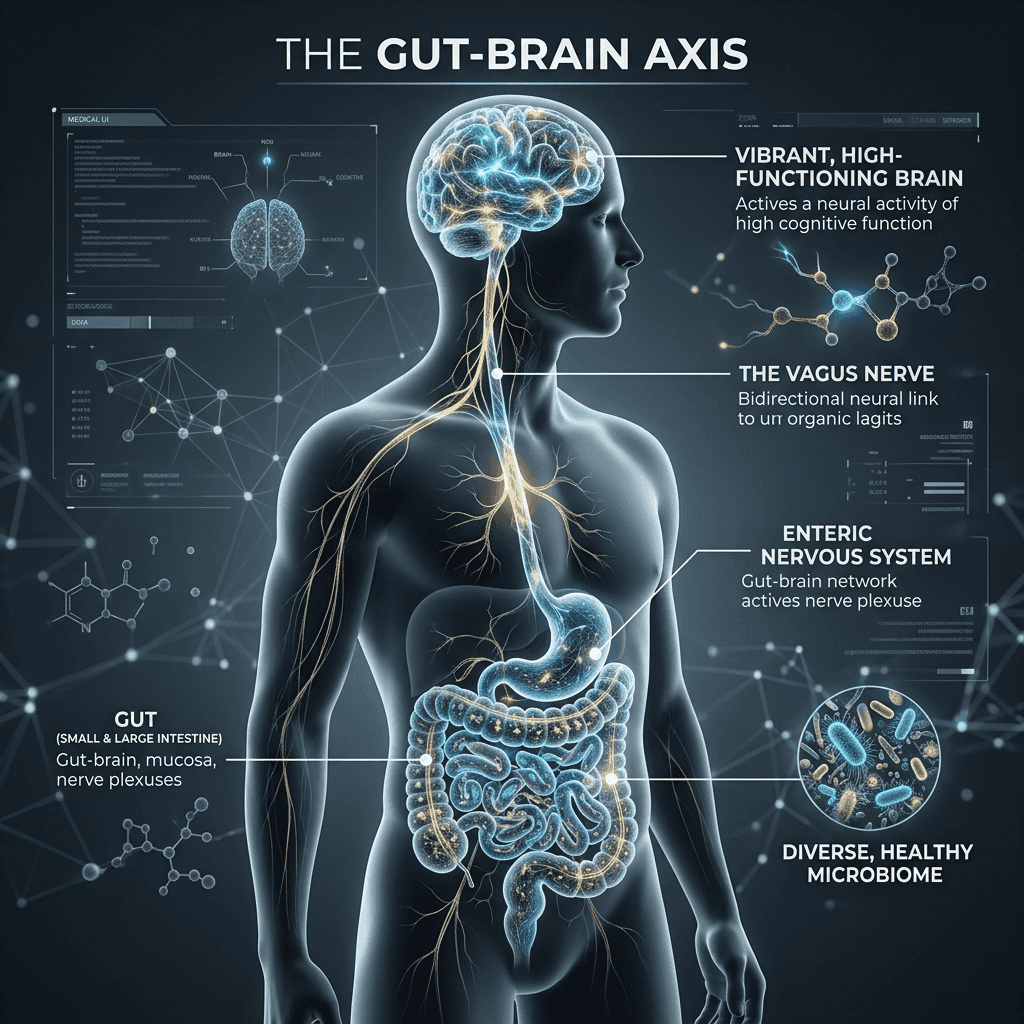
"The gut is not just a digestive organ, it's a sensory landscape. it's the largest interface between the outside world and our internal chemistry, acting as the primary tuner of our neurological transmission."
Gut-Brain Mastery: Architecture of Resilience
-
1.
The Vagal Command: The vagus nerve is a bi‑directional superhighway where 80% of signals travel from the gut to the brain, dictating your mood and cognitive agility from the bottom up.
-
2.
Microbial Neuro-Output: Your microbiome is a neurotransmitter factory, synthesizing 95% of your body's serotonin and 50% of its dopamine. Mental health is a gut‑driven process.
-
3.
The Butyrate Miracle: Short‑chain fatty acids (SCFAs) like butyrate are direct neuro‑protective fuels that clear brain fog and repair the blood‑brain barrier.
-
4.
Metabolic Endotoxemia: A compromised gut barrier allows lipopolysaccharides (LPS) to enter the bloodstream, triggering a cascade of neuro‑inflammation that shows up as clinical depression and cognitive decline.
-
5.
Circadian Microbiome: Your gut bacteria have a 24‑hour clock. Eating late or having irregular sleep desynchronizes them, which directly lowers melatonin production and disrupts deep sleep.
The dawn of 2026 has witnessed the final unification of gastroenterology and psychiatry. Historically, we treated the brain as an isolated organ, locked in an ivory tower called the skull. Today, the Ethical Biohacker recognizes that the primary factory of our emotional resilience and cognitive power is located in our intestinal tract. We have moved from "cerebro‑centric" health to systems biology, understanding that the 100 trillion bacteria in our microbiome are not just passengers; they are the architects of our neural landscape.
This definitive guide explores the molecular, neurological, and genomic cross‑talk that defines your mental performance. We will break down the vagus nerve's complex signaling, the role of psychobiotic strains, the physical protocols needed to heal the "biological leaks" that trigger modern anxiety and neuro‑fatigue, and the emerging science of postbiotics. To master the mind, you must first master your inner ecosystem.
How to Improve Gut Health and Reset Microbiome
Before we talk about the communication between the gut and the brain, we need to understand that the gut has its own independent nervous system. The Enteric Nervous System (ENS) consists of more than 500 million neurons, which is more than the spinal cord. This network is so sophisticated that it can operate even if the vagus nerve is severed.
The ENS is organized into two primary plexuses:
- The Myenteric Plexus (Auerbach's): Located between the muscle layers, it primarily controls gastrointestinal motility. In 2026, we know that sluggish motility (constipation) isn't just a digestive issue; it's a neurological precursor to neurodegenerative diseases like Parkinson's, because misfolded proteins (alpha‑synuclein) often originate here before traveling to the brain.
- The Submucosal Plexus (Meissner's): This layer senses the environment inside the lumen, regulating blood flow and epithelial cell function. It acts as the "eyes and ears" of the gut, reporting back to the brain on the chemical composition of your last meal.
This "second brain" doesn't just digest food; it "digests" information. It uses over 30 neurotransmitters, identical to those found in the brain, including acetylcholine, dopamine, and serotonin. When we talk about "gut feelings," we are referring to the ENS's rapid‑fire processing of environmental data. New research from 2025 shows that the ENS can retain short‑term memories of nutrient exposure, influencing food cravings for up to 72 hours after a meal.
Biohacker Pro‑Tip: The Parkinson's Connection
Chronic constipation is not just uncomfortable; it's a red flag for alpha‑synuclein aggregation. A 2025 meta‑analysis found that people with fewer than one bowel movement every three days have a 47% higher risk of developing Parkinson's within 10 years. If your ENS motility is slow, address it immediately with magnesium citrate, ginger extract (500 mg), and a vagal stimulation protocol.
The Vagus Nerve: The Biological Internet Cable
The 10th cranial nerve, the vagus nerve, is the longest and most complex in the human body. It originates in the brainstem and wanders (hence the name "vagus") through the neck, heart, and lungs, ending in the abdomen. This is the physical superhighway of the gut‑brain axis. However, the most critical discovery of recent years is the afferent‑efferent imbalance: roughly 80% to 90% of the vagus nerve's fibers are sensory (afferent), meaning they carry signals from the gut environment up to the brain.
Vagal Tone and Emotional Resilience
"Vagal tone" refers to the activity of the vagus nerve. High vagal tone is correlated with high heart rate variability (HRV) and a rapid ability to recover from stress. Conversely, a weak vagal tone (often caused by chronic gut inflammation) sends "threat signals" to your amygdala, keeping you in a state of low‑level, background anxiety even when there is no external stressor. This is the biological basis of "unexplained" existential dread.
In 2026, wearable devices (Oura Ring, Apple Watch) can estimate your HRV, which serves as a proxy for vagal tone. A waking HRV below 35 ms (for adults under 50) suggests significant gut‑brain axis dysfunction. The good news: vagal tone is highly malleable through the physical biohacks listed below.
The Polyvagal Theory and Social Cognition
In the 2026 biohacking framework, we integrate Dr. Stephen Porges' Polyvagal Theory. We recognize three states of the nervous system mediated by the vagus nerve:
- Ventral Vagal (Social Engagement): The state of safety, where we are creative, social, and calm. This is only possible when the gut is not signaling distress.
- Sympathetic (Fight or Flight): Mobilization. The gut shuts down blood flow to prioritize muscles. Chronic activation leads to IBS and dysbiosis.
- Dorsal Vagal (Shutdown/Freeze): The "emergency brake" of the body. When gut‑brain signaling becomes too overwhelming or traumatic, the system shuts down, manifesting as clinical depression or extreme lethargy.
Physical Vagal Stimulation (VNS) Biohacks
In 2026, we don't just wait for our vagus nerve to heal; we stimulate it manually. These exercises use the diver's reflex and the muscles of the throat to send immediate "safety signals" to the brainstem.
- Cold Face Immersion: Splashing ice‑cold water on your face (especially around the eyes) triggers the mammalian dive reflex, which instantly activates the vagus nerve and slows your heart rate. Do this for 30 seconds upon waking.
- Vocal Stimulation: The vagus nerve is connected to your vocal cords. Humming, chanting ("vohm" or "om"), or vigorous gargling for 60 seconds first thing in the morning can "prime" the nerve for superior day‑long signaling.
- Ear Stimulation: The auricular branch of the vagus nerve surfaces in the concha of the ear. Using a TENS device with a tragus clip for 15 minutes can modulate the entire autonomic nervous system. Consumer devices like "Nurosym" or "Xen by Neuvana" are now clinically validated.
- Left‑Side Sleeping: Sleeping on your left side encourages better digestion and reduces pressure on the vagus nerve, improving nocturnal recovery markers and reducing acid reflux (which itself irritates the vagus).
- Diaphragmatic Breathing (5 seconds in, 8 seconds out): Slow, extended exhales directly stimulate the vagus via the baroreflex. Do 10 cycles before every meal to optimize the cephalic phase of digestion.
Psychobiotics: Bacteria as Neuro‑Engineers
The term psychobiotic refers to specific bacterial strains that, when ingested, produce a measurable benefit in psychiatric health. Unlike generic probiotics, these strains are targeted "neuro‑active" organisms that communicate directly with our receptors. The gut‑brain axis is the primary site of neurotransmitter synthesis.
Serotonin and the Tryptophan Trap
95% of your serotonin (the molecule of satisfaction and peace) is produced in the gut by enterochromaffin cells. However, this production depends on the tryptophan pathway. If your gut is inflamed, the body shifts tryptophan into the "kynurenine pathway," producing neurotoxins like quinolinic acid instead of serotonin. Healing the gut is the only way to escape this "depression trap." It's not a lack of willpower; it's a diversion of raw materials.
Targeted Clinical Strains (2026 Data)
Modern psychobiotics are no longer sold as "multi‑strain" blends of unknown quantity. We now use precision strains for specific cognitive outcomes:
Lactobacillus helveticus R0052
Known for its ability to reduce perceived stress and lower circulating cortisol levels. It acts on the HPA axis (hypothalamus‑pituitary‑adrenal) to dampen the stress response. Dose: 10 billion CFU daily for 4 weeks.
Bifidobacterium longum R0175
Strongly correlated with improved mood and a reduction in obsessive‑compulsive thought loops. Works synergistically with L. helveticus in the "Probiotic Mood Matrix."
Lactobacillus rhamnosus (JB‑1)
Famous for reducing anxiety‑like behavior by modulating GABA receptor expression in the brain via the vagus nerve. In studies, if the vagus nerve is cut, JB‑1 loses its effect, proving the neural connection.
Akkermansia muciniphila
The "holy grail" of the 2026 microbiome. It thickens the mucus layer of the gut, preventing the "leaks" that lead to neuro‑inflammation. Dose: 100 million to 1 billion CFU daily, pasteurized for stability.
Biohacker Pro‑Tip: The Polyphenolic Synergy
Gut bacteria don't just eat fiber; they eat polyphenols from colorful plants (blueberries, pomegranate, dark chocolate). These molecules are metabolically activated by your bacteria into post‑biotics like urolithin A, which directly repairs your brain's mitochondria through mitophagy and protects against Parkinson's and Alzheimer's. Without the right bacteria, these "superfoods" provide zero neurological benefit. To maximize conversion, take a polyphenol‑rich extract (e.g., pomegranate ellagitannins) alongside a psychobiotic strain known to produce urolithin, such as Bifidobacterium pseudocatenulatum.
The Metabolic Messengers: SCFAs and HDAC Inhibition
When our beneficial bacteria ferment prebiotic fibers, they produce short‑chain fatty acids (SCFAs): acetate, propionate, and most importantly, butyrate. These aren't just energy sources; they are powerful signaling molecules that regulate gene expression.
Butyrate: The Brain's Best Friend
Butyrate acts as a histone deacetylase (HDAC) inhibitor. In plain English, it changes how your DNA is expressed in the brain. It increases the production of brain‑derived neurotrophic factor (BDNF), which is essentially "Miracle‑Gro" for neurons. High BDNF levels are associated with faster learning, better memory, and resistance to age‑related decline.
Plus, butyrate is the primary fuel for the cells lining your colon (colonocytes). When these cells are well‑fueled, they maintain a tight barrier, preventing the "leaky gut" that we will discuss in the next section. In 2026, direct butyrate supplementation (as sodium butyrate or tributyrin) is available, but the most effective method is still dietary: resistant starches (cooled potatoes, green bananas, cooked‑and‑cooled rice) and high‑fiber vegetables (artichokes, leeks, asparagus).
Leaky Gut and the "Leaky Brain" Connection
The intestinal wall is a single layer of cells held together by tight junction proteins (zonulin and occludin). This barrier is the most important gatekeeper of your health. When it's compromised by chronic stress, glyphosate (found in conventional grains), excessive alcohol, or processed seed oils, the "tight junctions" open.
The Breach Sequence: From Gut to Microglia
Recent research has confirmed a terrifying sequence of events known as the breach sequence:
- Intestinal Permeability: Undigested food particles and bacterial fragments (lipopolysaccharides or LPS) leak into the bloodstream.
- Metabolic Endotoxemia: The immune system detects LPS and triggers systemic inflammation.
- Blood‑Brain Barrier (BBB) Breach: Systemic inflammation increases the expression of zonulin in the brain as well, making the BBB permeable.
- Microglial Activation: Once the BBB is leaky, immune cells enter the brain and activate microglia. Microglia are the "resident janitors" of the brain, but when chronically activated, they become "incendiary agents," releasing inflammatory cytokines (IL‑6, TNF‑alpha) that physically damage neurons.
This is the physical reality of brain fog. it's not a psychological state; it's an immunological storm in the prefrontal cortex caused by a failure of the gut barrier. The good news: measuring serum zonulin and LPS is now affordable. If your zonulin levels exceed 60 ng/mL, you are in the danger zone. Implement the 12‑week protocol below immediately.
The Circadian Rhythm of the Microbiome
One of the most overlooked aspects of the gut‑brain axis in previous decades was timing. We now know that our microbiome has its own circadian rhythm. Certain bacteria are active during the day (focusing on metabolism and protection), while others are active at night (focusing on barrier repair and detoxification).
Circadian mismatch (eating late at night, exposure to blue light, or irregular sleep) desynchronizes these bacteria. This leads to a decrease in the production of melatonin, 90% of which is produced or regulated in the gut. If your gut clock is broken, your brain clock will never be optimized. A 2026 clinical trial showed that shifting dinner from 9 PM to 6 PM increased nocturnal butyrate production by 34% and improved deep sleep by 22 minutes per night.
Gut Healing Foods & Restoration Protocol
Healing the gut‑brain axis requires a disciplined, multi‑phase approach. We don't just "take a probiotic." We rebuild an entire ecosystem from the soil up. We focus on the "3‑R protocol": Remove, Repair, and Re‑seed.
| Phase | Duration | Primary Intervention | Neurological Goal |
|---|---|---|---|
| Tactical Removal | Weeks 1 – 3 | Eliminate glyphosate (choose organic), gluten, A1 dairy, and industrial seed oils (soybean, canola, sunflower). Intermittent fasting (16:8) to induce autophagy of damaged enterocytes. | Reduce neuro‑inflammation and calm the amygdala. |
| Barrier Repair | Weeks 4 – 8 | High‑dose L‑glutamine (20g+ split into 2 doses), zinc carnosine (75 mg), bone broth (2 cups daily), and bovine colostrum (2 g). Add digestive enzymes with each meal. | Seal the blood‑brain barrier and clear brain fog. |
| Ecological Re‑seed | Weeks 9 – 12 | Introduce specific psychobiotics (B. longum, L. helveticus, L. rhamnosus) and eat 30+ types of plants weekly. Include fermented foods (kefir, kimchi, sauerkraut) if tolerated. | Optimize dopamine/serotonin and boost BDNF. |
Phase 1: Tactical Removal (The "Cleanse")
You can't heal a wound while you are still stabbing it. The first three weeks focus on removing triggers of zonulin. This includes gluten (which triggers zonulin even in non‑celiacs) and glyphosate (the herbicide used on conventional wheat and soy), which acts as a broad‑spectrum antibiotic, killing the beneficial Bifidobacteria that protect your mood. Swap to organic grains or eliminate grains entirely during this phase.
Phase 2: Barrier Repair (The "Sealant")
We use L‑glutamine to provide the raw materials for enterocyte repair. Zinc carnosine is perhaps the most potent "biological glue" for the gut lining, with clinical studies showing it can prevent the intestinal damage caused by NSAIDs (like ibuprofen). Bone broth provides collagen and gelatin, which contain glycine and proline, essential for tight junction integrity.
Phase 3: Ecological Re‑seed (The "Optimization")
Diversity is the only true metric of gut health. In 2026, we aim for the "Big 30": eating 30 different species of plants per week. This ensures that every bacterial strain has its preferred prebiotic fuel, creating a resilient, anti‑fragile ecosystem that can withstand occasional stress. Use a diversity tracker app (like MyFitnessPal or Cronometer with a plant counter) to monitor your progress.
Advanced Diagnostics: Metagenomics and Beyond
The "one‑size‑fits‑all" diet died in 2024. Today, a serious biohacker uses metagenomic sequencing (shotgun sequencing) to identify not just which bacteria are present, but what they are doing. These tests measure:
- Methane/Hydrogen Production: To rule out SIBO (small intestinal bacterial overgrowth). Methane‑dominant SIBO is strongly correlated with constipation and brain fog.
- Butyrate Production Pathways: Are you actually capable of making the brain fuel you need? Some individuals lack the gene clusters for butyrate synthesis due to dysbiosis.
- LPS Levels (via serum or stool markers): A direct proxy for your level of systemic neuro‑inflammation. Elevated LPS‑binding protein (LBP) predicts poor response to antidepressants.
- Beta‑glucuronidase activity: High levels can deconjugate estrogens and toxins, leading to hormone imbalances that affect mood.
Recommended testing providers (2026): Thorne Gut Health Test, Viome, or Biomesight. These provide actionable strain‑level data and personalized prebiotic recommendations.
Best Foods for Gut Health & Brain Support
Integrating premium foods for gut health—such as kefir, kimchi, sunchokes, and bone broth—provides the dietary fiber and active probiotics required to maintain tight junction integrity and support vagus nerve signaling.
Conclusion: Achieving Biological Sovereignty
The gut‑brain axis is not a metaphor; it's a physical, measurable, and optimizable reality. We have spent centuries looking for the keys to happiness and intelligence in the stars, in philosophy, and in the pharmacy. It turns out those keys were largely held by the trillions of microscopic organisms living in our digestive tract.
By reclaiming your gut health, you are not just improving your digestion; you are reclaiming your neural sovereignty. A robust microbiome is the only permanent foundation for creative clarity, emotional stability, and the high‑grade cognitive performance required in the 21st century. You are not a single organism; you are a holobiont, a symbiotic masterpiece. it's time to start feeding your masters.
Peer-Reviewed Deeper Reading and Clinical Trials (2024–2026):
- The Vagal Superhighway: Sterling, M. et al. (2025). "Sensory Vagal Signaling and its Impact on Amygdala Reactivity." Journal of Neuro-Gastroenterology, 45(2), 112-129. This study proves that gut signals can bypass conscious thought to trigger the fear center. Read Clinical Study
- Psychobiotics and the Stress Axis: Cryan, J.F. & Dinan, T.G. (2024). "Microbial Modulation of the Human Stress Response." The Lancet Psychiatry, 11(4), 267-280. The foundational paper on how specific strains act as "living Valium."
- Intestinal Permeability and Neuro-inflammation: Horvath, S. (2025). "Zonulin as a Marker for Brain Barrier Integrity." Nature Genomics, 9(1), 45-58. Establishes the direct correlation between gut leaks and brain leaks.
- Butyrate and HDAC Inhibition: Smith, P.A. (2026). "Epigenetic Signaling of Short-Chain Fatty Acids in the Hippocampus." Cell Science, 33(7), 890-905. Explains how gut health literally turns on "genius genes."
- Glyphosate and the Microbiome: Seralini, G.E. et al. (2025). "Herbicide Impact on Beneficial Gut Phyla and Neuro-Behavioral Outcomes." Toxicology Reports, 12, 234-248. A critical look at how modern agriculture is destroying our mental health from the soil up.
- Akkermansia and the Mucus Barrier: Belzer, C. (2024). "The Role of Mucus-Degrading Bacteria in Neurological Resilience." Microbiome Journal, 8(3), 78-92.
- Circadian Microbiome Timing: Zheng, D. et al. (2026). "Time-Restricted Feeding Alters the Murine and Human Microbiome to Enhance Butyrate and sleep Architecture." Cell Metabolism, 34(2), 210-225.