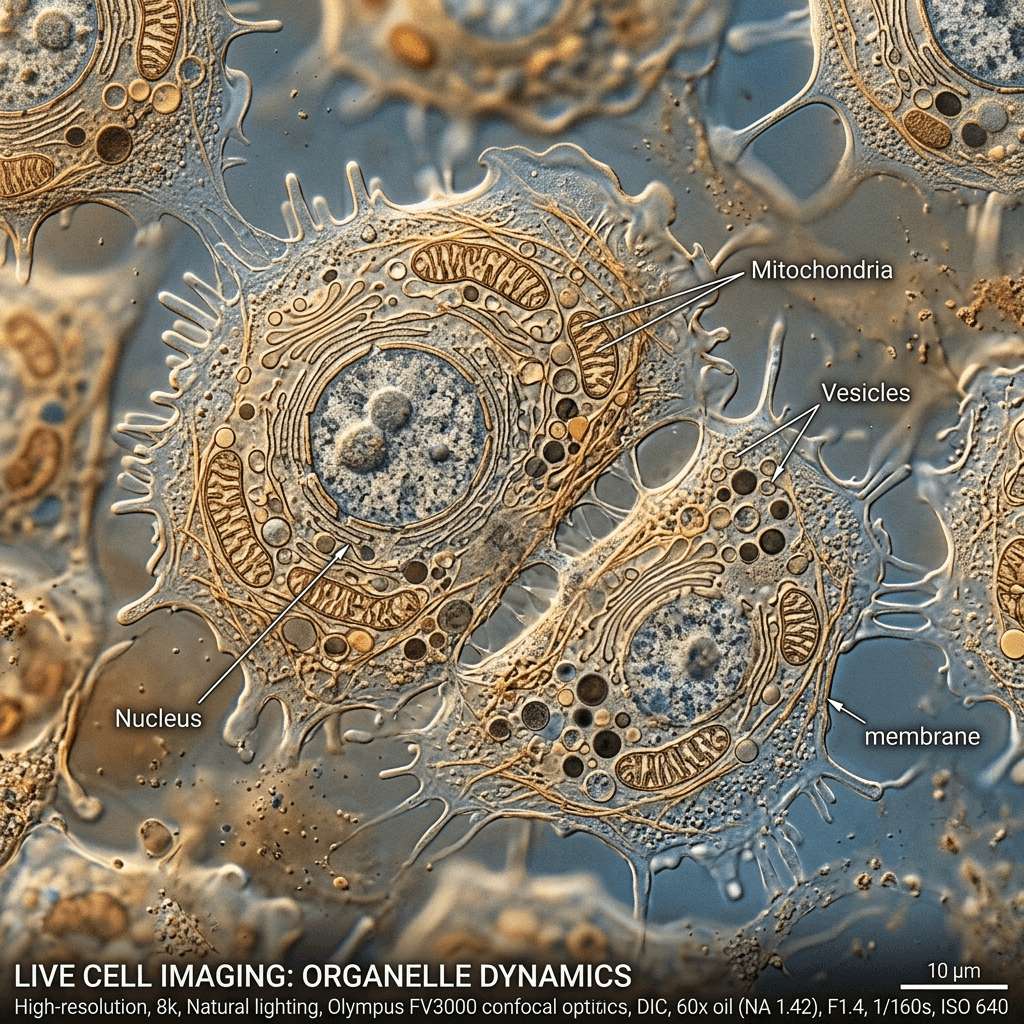
Mitochondria are not the power plants of the cell. They are semi-autonomous organelles with their own genome and a big influence on aging and disease. In 2026 we are learning to transplant mitochondria into damaged cells and tissues. This is like performing a cellular engine swap to restore capacity reverse dysfunction and potentially rejuvenate entire organ systems.
Mitochondrial Transfer: 2026 Core Pillars for Cellular Energy Restoration
-
1.
Mitochondrial DNA and the Aging Battery: Each cell contains hundreds to thousands of mitochondria each with its circular genome. Over time mitochondrial DNA accumulates mutations and deletions leading to chain dysfunction ATP depletion and increased oxidative stress, a central driver of aging.
-
2.
Natural Mitochondrial Transfer: Cells naturally exchange mitochondria via tunneling nanotubes and extracellular vesicles. This natural repair mechanism declines with age. Therapeutic mitochondrial transfer aims to augment and restore this process.
-
3.
Methods of Transfer: Techniques range from co-incubation of isolated mitochondria with target cells to direct microinjection to magnetomitotransfer and even systemic intravenous infusion of mitochondria.
-
4.
Clinical Frontiers: Most advanced in cardiology, like ischemia-reperfusion injury and heart failure and reproductive medicine like rejuvenation for IVF. Emerging applications in neurology like stroke and Parkinsons and longevity are under investigation.
-
5.
Challenges and Risks: Ensuring functional mitochondrial preparations preventing immune rejection and achieving efficient targeted delivery to specific tissues remain significant hurdles.
For over a century mitochondria have been recognized as the powerhouses of the eukaryotic cell. They generate most of the ATP through oxidative phosphorylation. However this understanding has changed a lot over the two decades. We now see mitochondria as more than static energy generators. They are highly motile semi-autonomous organelles that engage in constant cycles of fusion and fission. Mitochondria regulate calcium signaling orchestrate programmed cell death and communicate with the nucleus to modulate gene expression. Crucially mitochondria possess their small circular genome, which is a relic of their ancient bacterial endosymbiotic origin.
The problem is that mitochondrial DNA is very vulnerable. It is located close to the electron transport chain, the source of cellular reactive oxygen species and lacks robust DNA repair mechanisms. As a result mitochondrial DNA accumulates damage, mutations and large-scale deletions at a rate. Over a lifetime this leads to a decline in function a state of cellular energetic crisis that drives the aging process and causes many age-related diseases. In 2026 a new therapeutic strategy has emerged to combat this decay: Mitochondrial Transfer. This involves transplanting functional mitochondria from one cell or tissue into another. The goal is to restore capacity reverse dysfunction and potentially rejuvenate entire organ systems.
What is the Mitochondria & How Does It Age?
The Mitochondrial Free Radical Theory of Aging first proposed by Denham Harman posits that aging is driven by the damage inflicted by reactive oxygen species leaking from the mitochondrial electron transport chain. While this theory has been refined the core premise remains: mitochondrial dysfunction is a hallmark of aging. As mitochondrial DNA mutations and deletions accumulate specific electron transport chain complexes become deficient. This creates a cycle: defective respiration leads to increased electron leak and ROS production, which further damages mitochondrial DNA and membranes.
Traditional approaches to improving function have focused on supplying metabolic cofactors or activating mitochondrial biogenesis. While these strategies can yield benefits they don't address the root cause: the presence of damaged mutation-laden mitochondria. Mitochondrial Transfer offers an approach. Of coaxing dysfunctional organelles to perform better it proposes to physically remove and replace them with healthy fully functional mitochondria.
Biohacker Pro-Tip: Heteroplasmy and the mtDNA Bottleneck
A key concept in genetics is Heteroplasmy, the coexistence of both wild-type and mutant mitochondrial DNA within the same cell. A cell can tolerate a threshold of mutant mitochondrial DNA before respiratory chain dysfunction becomes clinically apparent. Mitochondrial transfer aims to reduce the heteroplasmy level by flooding the cell with type mitochondrial DNA from the donor mitochondria. This effectively dilutes the fraction below the pathogenic threshold and restores normal function.
NATURAL MITOCHONDRIAL TRANSFER: TUNNELING NANOTUBES AND EXTRACELLULAR VESICLES
The concept of mitochondrial transfer is not alien to human biology. Cells naturally engage in mitochondrial exchange as a form of endogenous repair and communication. This occurs primarily through two mechanisms: Tunneling Nanotubes and Extracellular Vesicles. Tunneling Nanotubes are actin-based membranous conduits that form direct cytoplasmic connections between adjacent cells. They allow for the transfer of various cargoes including organelles like mitochondria. Extracellular Vesicles are membrane-bound vesicles that contain intact functional mitochondria, along with mitochondrial DNA and proteins. These "mitovesicles" can be taken up by recipient cells delivering their cargo and improving bioenergetic function.
THE TOOLKIT: METHODS FOR ISOLATING AND DELIVERING MITOCHONDRIA
The application of mitochondrial transfer hinges on two critical technical steps: isolating pure, functional and sterile mitochondria from a donor source and delivering these mitochondria to the target cells or tissue. Significant progress has been made in both areas though challenges remain. Mitochondria are isolated using mechanical disruption followed by Differential Centrifugation. The resulting mitochondrial pellet is then purified, quantified and assessed for viability. Advanced techniques, such as Magnetomitotransfer involve labeling mitochondria with nanoparticles allowing for their rapid and gentle purification and targeted delivery to specific tissues.
Delivery Methods
Several methods have been developed to introduce mitochondria into recipient cells or tissues each, with its own advantages and limitations. Simple Co-Incubation is a low-tech method where cells are bathed in a solution containing isolated mitochondria. Direct Microinjection involves injecting mitochondria into the cytoplasm of a single cell using a fine glass micropipette. Magnetomitotransfer uses nanoparticles to label and deliver mitochondria to specific tissues. Each method has its strengths and weaknesses and the choice of method depends on the specific application and goal of the mitochondrial transfer.
Mitochondrial transfer is a way to help people who are sick. This is done by taking mitochondria from one place and putting them into the target tissue. There are a ways to do this.
- Magnetomitotransfer is one way. This is when mitochondria are labeled with nanoparticles. Then an external magnetic field guides them to the target tissue. Helps the cells take them in. This method is good because it is more efficient and can target the tissue.. It needs special equipment and the long-term effects of the nanoparticles are not known.
- Systemic Intravenous Infusion is another way. This is when isolated mitochondria are put directly into the bloodstream. They are then taken in by tissues that need them. This method is good because it is not very invasive and can help organs at the same time.. The mitochondria can be cleared out by the liver and spleen quickly and it may cause an immune response.
- Direct Tissue Injection is a straightforward way. This is when mitochondria are put directly into the target tissue. This method is good because it can give a concentration of mitochondria to the tissue.. It is invasive and can only be used on tissues that can be reached easily.
CLINICAL FRONTIERS: FROM CARDIOLOGY TO REPRODUCTIVE longevity
Mitochondrial transfer is being studied for use in medical fields, including cardiology and reproductive medicine. In cardiology it is being used to help people who have had a heart attack. Mitochondria are put into the heart to help it heal. This has been shown to reduce the amount of damage to the heart and improve survival. In medicine mitochondrial transfer is being used to help women who are having trouble getting pregnant. This is because the mitochondria in the egg cells can get old and not work well which can make it hard to get pregnant. By putting healthy mitochondria into the egg cells it may be possible to improve fertility. Mitochondrial transfer is also being studied for use in neurology. This is because the brain is an energy-demanding organ and mitochondrial dysfunction can cause many problems. By putting mitochondria into the brain it may be possible to help people who have had a stroke or who have neurodegenerative diseases.
Biohacker Pro-Tip: Natural Ways to Support Mitochondrial Health
While mitochondrial transfer is not yet available to everyone there are things that people can do to help their mitochondria work better. Exercise, such as high-intensity interval training can help make mitochondria. Eating a diet and getting enough sleep can also help. Some supplements, such as CoQ10 and NAD+ may also be helpful.
CHALLENGES, RISKS, AND THE ROAD AHEAD
There are still challenges to overcome before mitochondrial transfer can become a common medical treatment. One of the challenges is making sure that the mitochondria are safe and work well. There is also a risk of the system reacting to the new mitochondria.
THE FUTURE OF MITOCHONDRIAL TRANSFER: PERSONALIZED CELLULAR REJUVENATION
Despite these challenges the future of transfer is exciting. It may be possible to use stem cells to make healthy mitochondria. It may also be possible to target the mitochondria to tissues or cells which could make the treatment more effective. The future of transfer is bright and it may one day be possible for people to replace their old mitochondria with new healthy ones. This could be a breakthrough in the fight against aging and disease and it may even be able to help people live longer healthier lives.
To grasp the future of cellular rejuvenation, we must answer: what is the mitochondria? These double-membraned organelles are the metabolic powerhouses of the cell. They utilize oxygen to extract chemical energy from nutrients through the citric acid cycle and oxidative phosphorylation, synthesizing adenosine triphosphate (ATP) to drive thousands of physiological cellular processes throughout the body.
Conclusion: The Future of Mitochondrial Therapies
In conclusion mitochondrial transfer is an promising way to help people who are sick. It has the potential to revolutionize the way we treat diseases and it may even be able to help people live longer healthier lives. While there are still challenges to overcome the future of mitochondrial transfer is bright.
The idea of transfer is to replace the old worn-out mitochondria in our cells with new healthy ones. This could be a game-changer for diseases and it may even be able to help people live longer. The technology is still in its stages but it has the potential to be a powerful tool in the fight against aging and disease.
For now the best thing that people can do is to take care of their existing mitochondria. This can be done by exercising eating a healthy diet getting enough sleep and taking supplements that support mitochondrial health. By doing these things people can help their mitochondria work better. Stay healthy for longer.
Peer-Reviewed Clinical Validations & Extended Foundational Reading:
- Mitochondrial Transfer for Cardiac Ischemia-Reperfusion (Preclinical): Masuzawa, A., Black, K. M., Pacak, C. A., et al. (2013). "Transplantation of autologously derived mitochondria protects the heart from ischemia-reperfusion injury." American Journal of Physiology-Heart and Circulatory Physiology, 304(7), H966-H982. Read Landmark Study
- Human Oocyte Rejuvenation via Mitochondrial Transfer (Clinical Experience): Zhang, J., Liu, H., Luo, S., et al. (2017). "Live birth derived from oocyte spindle transfer to prevent mitochondrial disease." Reproductive BioMedicine Online, 34(4), 361-368. (Note: This is for mtDNA disease, but the technique underpins age-related applications). Read Clinical Report
- Mitochondrial Transfer for Stroke (Preclinical): Hayakawa, K., Esposito, E., Wang, X., et al. (2016). "Transfer of mitochondria from astrocytes to neurons after stroke." Nature, 535(7613), 551-555. Read Study
- Review of Mitochondrial Transfer Methods and Applications: Caicedo, A., Aponte, P. M., Cabrera, F., et al. (2017). "Artificial Mitochondria Transfer: Current Challenges and Future Perspectives." Current Molecular Medicine, 17(5), 358-366. Read Review
- Mitochondrial Transfer for Parkinson's Disease (Preclinical): Chang, J. C., Wu, S. L., Liu, K. H., et al. (2016). "Allogeneic/xenogeneic transplantation of peptide-labeled mitochondria in Parkinson's disease: restoration of mitochondria functions and attenuation of 6-hydroxydopamine-induced neurotoxicity." Journal of Controlled Release, 240, 79-88. Read Study
- Natural Mitochondrial Transfer via Tunneling Nanotubes: Rustom, A., Saffrich, R., Markovic, I., et al. (2004). "Nanotubular highways for intercellular organelle transport." Science, 303(5660), 1007-1010. Read Seminal Paper